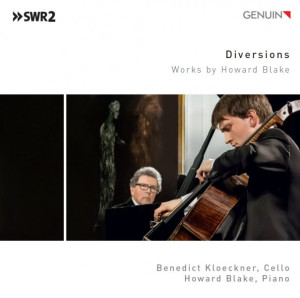
Diversions
Diversions for Cello and Piano
A suite for cello and piano transcribed from the work for cello and orchestra, opus 327. Definitive cello and piano version
First Performance: Martin Rummel (cello) and Howard Blake (piano), The British Music Information Centre, May 2000.
‘Diversions’ was originally conceived as a suite for cello and piano as far back as 1973. In 1984 the great French cellist Maurice Gendron encouraged the composer to rework the piece for cello and orchestra, and he himself edited the cello part. The first performance of the work in this orchestral form was given by Steven Isserlis and The Royal Philharmonic Orchestra conducted by Sir Charles Groves at The Fairfield Halls Croydon on 29th March 1989. This transcription for cello and piano was made by the composer at about the same time
Programme-note by the composer: The work pays mischievous homage to instrumental suites of the past. The Scherzo is not quite a scherzo, the March more than a march. The Waltz has a wrong-stepping jazz tinge to it, the Aria a sudden profundity. The Serenade bursts into arrogant display, the guitar-like Sarabande becomes an eloquent cadenza. We are led back to the theme of the Prelude via a Finale of such bristling virtuosic energy that its simple melodic line assumes a far more complex character – having been well and truly ‘diverted’.
A new lease of life was given to the work in November 2010 when the brilliant young German cellist, Benedict Kloeckner, accompanied by Spanish pianist Jose Gallardo, won the penultimate round of the EBU Young Artists Competition in Bratislava, which led to Benedict playing the Elgar Concerto and winning the entire contest. To celebrate the event Howard transcribed his violin sonata for cello and piano and in the following Spring assembled an entire recital of cello and piano music for Benedict, which the two of them performed in concert in the Historisches Cafehalle in Schlangenbad near Mainz on May 8th 2011. The recital consisted of Pennillion, Diversions, Jazz Dances, Cello Sonata and various encores, including a new cello and piano version of ‘Walking in the Air’.An English composer with a pronounced lyrical gift, Howard Blake (b. 1938) is perhaps best known for his soundtrack to the feature cartoon, “The Snowman,” which has a hauntingly beautiful refrain “Walking in the Air” for boy soprano and orchestra. He has a body of more “serious” works though, and we can hear some of how that sounds on a new recording featuring works for cello and piano, Diversions (SWR2/Genuin 15346). Benedict Kloeckner takes on the cello role for these works and sounds terrific. Howard Blake himself handles the piano part with dramatic credibility. These are modern lyric pieces that show us Blake the gritty but mellifluous contemporary composer in a series of six compositions, all but one enjoying world premier recordings in the versions presented. This is music of a pronounced tonality but without anything in the way of a neo-classical glance at the past. He may certainly have something of the romantic in him, but like Samuel Barber it is so individual that you don’t find yourself saying, “yes, that is Brahmsian…that is Mendelssohnian, etc.” The works hold their own as contemporary music with a pronounced Blakean signature affixed. There is nothing banally “new age” sounding to them either. The music is filled with inventive flourishes that evince a fertile creative mind at work.
The piano parts occasionally step into the spotlight but mostly this is music that gives the cellist a chance to take a singing melodic lead. Kloeckner responds with an extraordinarily vibrant tone and rhapsodic lucidity.
There is nothing in the way of filler. Each work has something to say. We get a touching rendition of “Walking in the Air” that reminds us how well-constructed the deceptively straightforward song is. But then we get more complexly lyrical works in the title work “Diversions for Cello & Piano,” in “Pennillion for Cello & Piano,” the “Cello Sonata,” and “The Enchantment of Venus.” The program concludes with a short and very lovely “Archangel’s Lullaby” and we are done.
This is music any classical Anglophile will appreciate. It has an accessibility that will appeal to a large audience, potentially. And it is rousingly good music. It is not high modernist but it is thoroughly contemporary. It has a special quality to it that belongs very much to the musical personality of Howard Blake.
Very much recommended.
Movements
- 1:
- Prelude (moderato) 1min 28sec
- 2:
- Scherzo (vivace) 1min 3sec
- 3:
- March (tempo Di Marcia)
- 4:
- Waltz (vivo) 2min 43sec
- 5:
- Aria (andante Espressivo) 4min 26sec
- 6:
- Serenade (allegretto) 2min 30sec
- 7:
- Sarabande (lento Non Troppo) 3min
- 8:
- Finale (vivo) 3min 27sec
Recordings